La Chandleur

Today is  “La Chandleur”.  This holiday dedicated to eating crêpes takes place on February 2nd every year.  Not everyone in France celebrates La Chandleur (which I don’t really understand; who would want to miss out on an excuse to eat crêpes? )  La Chandleur has its origins in the Roman festival “Lupercales” when as part of their celebration the Romans ate (you guessed it!) crêpes!  For a great article on La Chandleur’s history and relationship to Groundhog Day go to http://french.about.com/od/culture/a/chandeleur.htm?r=et

Meanwhile, here is my recipe for crêpes:


Crêpes

One cup of flour

Two cups of milk

A half cup of sugar

A teaspoon of vanilla

Two eggs

Mix these ingredients together and refrigerate them for at least a half hour  (The batter will last for days in the refrigerator if you don’t finish it all right away).  Place a (large!) pat of butter in a small saucepan and heat until the butter melts.  Pour about half a ladle of batter into the bottom of the saucepan.  Swirl the saucepan so that the batter covers the bottom evenly.  Cook over medium heat until small bubbles start to form beneath the crêpe.  Lightly separate the edges of the crêpe from the sides of the saucepan with the spatula, flip the crêpe and cook other the other side.  Please note:  This sounds complicated but in fact is extremely simple.  The measurements are approximate and it is easy to tell when the bottom side of the crêpe is cooked.  The first few times you flip your crêpes you might want to do so in the pan with your spatula, but even flipping crêpes in the air is not difficult.  The secret to that is using lots and lots of butter so that the crêpes won’t stick to the pan.  Bon appétit et Joyeuse Chandleur!

Brennan’s Brandy Milk Punch

When I was a senior in high school Auburn made it to the Super Bowl.  My Dad, who graduated from Auburn and has been a die-hard “War Eagle” football fan ever since he was in school there (or maybe before. . .) decided to go, and to take us with him.  It was the first time I had ever been to New Orleans.  Many years later I did my Ph.D. at Tulane, but that is another story. . .

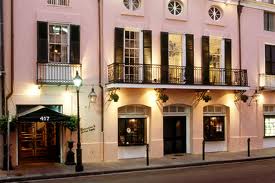
It was freezing cold during our whole visit.  Despite that, my parents were determined that we would see all the big sights of New Orleans, and that included eating in its most famous restaurants.  “Breakfast at Brennan’s” is one of those tourist “must-dos” and Brennan’s is credited with having invented the milk punch.  I was too young to have my own milk punch, although my mother did let me have a sip of hers.

Something about the cold here in DC today made me think of that long-ago visit and discovery of Brennan’s and its milk punch.

While looking online for the recipe I found a great site, nola.com, with plenty of great information on (and recipes from) New Orleans.  Among them I found Keith Marszelek’s blog entry on the Brandy Milk Punch.  The video Marszelek included in his post is not from Brennan’s, but watching The Ritz-Carlton New Orleans’ master-mixologist prepare the cocktail is certainly a none-too-shabby treat!

Enjoy and stay warm. . .maybe with some help from a Brandy Milk Punch. . .

N.O.’s best cocktails: The Brandy Milk Punch

Published: Monday, October 01, 2007, 9:11 AM     Updated: Monday, March 24, 2008, 2:33 PM
Keith I. Marszalek / NOLA.comChris McMillian prepares a classic New Orleans brunch cocktail, the Brandy Milk Punch.

If you’re in New Orleans, it must be time to enjoy a nice drink. And as sure as the sun will rise, watering holes from the Marigny to Uptown and from Downtown to Mid-City are ready to lend a helping hand.

But what makes one bar or bartender better than another? The quality of drinks they pour is as good a place as any to start. Speak out and tell us who makes the best Collins in town!

The Ritz-Carlton New Orleans’ master-mixologist Chris McMillian walks us through the history and preparation of this classic cocktail.

This week: The Brandy Milk Punch

The Brandy Milk Punch is a classic New Orleans brunch drink, often found in restaurants of the caliber of Cafe Adelaide, Brennan’s, Galatoire’s and Commander’s Palace. It is also a tradition pick-me-up for those requiring a taste of the “dog that bit them.”

According to McMillian, the drink calls for one and one half ounces of brandy a cup of whole milk, an ounce and a half of simple syrup, cracked ice and freshly grated nutmeg.

The Brandy Milk Punch

1 ½ ounces brandy
1 ounce simple syrup
½ bar spoon high quality vanilla extract
A couple ounces of Half-and-half
Cubed ice
Grated nutmeg

Pour brandy, simple syrup, vanilla extract and half-and-half into a pint glass. Add ice to a shaker and shake the concoction until well mixed and frothy. Add cubed ice to a rocks glass and, using a strainer, pour the mixture into it. Top with a bit of grated nutmeg.

Learn French in DC  –Learn French in the DC Metro Area  —  French Lessons in DC — French Lessons in the DC Metro Area  —  French in DC — French in the DC Metro Area

Creating Stories to Use in Children’s Classes

I teach all ages and levels, which I love because it keeps me challenged and my teaching fresh.  Some of my favorite classes are the ones I do with children.  I created this story to use with some of my youngest students.

I like to create my own stories (and songs) because by doing so I am able to center them around the vocabulary, idiomatic expressions and grammatical structures I have been teaching my students.  When I teach children stories I like to have the children act out the stories, both while we read them together and afterward in small groups.  Sometimes I will also have students make craft projects, including small books wherein they recopy and illustrate the story or puppets of the characters they then use to preform plays based on the story.

Children love to watch themselves, so sometimes I will film them, or the puppet presentations they create, on my Flip camera.  The stories I write are short and simple and often incorporate rhyme so they are not difficult for children to memorize.  Older children can also formulate simple sentences restructuring the vocabulary of the story and thereby summarize the stories in their own words.

Your students, particularly children in second grade and beyond, will also able to answer simple questions about the story if you first teach them the “question words” (“who”, “what”, “when”, “where”, etc.) you will use in posing your questions.  This is easier for them to do if you post the “question words” on the board and point to these “question words” as you use them and if you ask your questions in the order they occur in the story.  You might also want to write out your questions on the board so that students can see the questions the first time you ask them; this is especially helpful to visual learners when they initially hear the questions.  Of course after your students have already seen and heard the questions once you will want to erase them from the board.  After all, their goal is to learn to understand and respond to spoken French.   🙂

This is a story I wrote about a snail’s gift to the flower he loves.  I have included a translation at the end of the story.

L’Escargot Amoureux


Un escargot 

Se promenait

Dans une fôret.

Qu’est-ce qu’il cherchait,

Notre escargot?

Quelque chose de beau.

Parce qu’il aimait

De tout son Coeur

Une jolie fleur

Et il voulait

Lui donner

Un beau cadeau.

Il a trouvé

Un bel oiseau

tout bleu et gris

Qu’il a assis

Puis doucement pris

Sur sa coquille

À son amie.

Story of a Snail in Love

A snail went walking in a forest.

What was our snail looking for?

Something nice.

He was completely in love with a flower.

And he wanted to give her a beautiful gift.

He found a pretty bird, all blue and grey.

He put it on his shell and carefully took it back to his girlfriend.

“Cent Ans” par Renaud

I have earlier written about both Renaud and Coluche; you can find my posts on them (“Mistral Gagnant” and “Coluche”, respectively) in the “Songs” and “French Popular Culture” categories of this blog.

In 1988 Renaud released his album “Putain de Camion”.  It carried the name of the final track, a song he wrote in homage to Coluche (the two were close friends) after Coluche’s death in 1986.

One of my favorite songs on “Putain de Camion” is “Cent Ans”.  I thought of the song today because I have been sick these last few days and a cluster of four lines in the song, in classic French humor noir says “I am 100 years old and  I’m quite happy.  I have another toothache.  But suffering is very reassuring.  It only happens to the living.”

I discovered this song in 1996 when my (then) husband sang me those very lines while I was recovering from a broken leg.  I didn’t find the lines very funny at the time, but since I am currently only suffering from allergies, I got a kick out of the lines when they popped into my head this morning.

I have inserted a clip of Renaud singing “Cent Ans”, the lyrics and my translation of them below:

Cent Ans
Gidon, Pierre Jean Alex; Sechan, Renaud

J’ai cent ans et j’ suis bien content,
J’ suis assis sur un banc.
Et je regarde les contemporains,
C’est dire si j’ contemple rien.
J’ file des coups d’ canne aux passants,
Des coups d’ pompe aux clébards,
Qui m’énervent et j’ me marre.
On peut rien m’ dire, j’ suis trop vieux,
Trop fragile, trop précieux.
J’ai cent ans, qui dit mieux.

J’ai plus d’amour, plus d’ plaisir,
Plus de haine, plus d’ désirs,
Plus rien.
Mais j’ suis comme le platane,
Un peu d’ pluie, j’ suis en vie, ça m’suffit.
J’ suis bien.

J’ai des marmots qui m’ courent partout autour,
Des gonzesses moins, mais ça mange pas d’ pain.
J’ parle aux oiseaux, comme disait l’autre idiot,
Et j’ me d’mande où j’ai mis mon chapeau.

J’ai cent ans et j’ suis bien content,
J’ai encore mal aux dents.
Mais la souffrance, c’est très rassurant.
Ça n’arrive qu’aux vivants.
J’attends tranquille sur mon banc
Que ce vieux monde explose,
Tant il se décompose.
Moi ça fait quatre vingt quinze ans
Que j’ crois plus à grand chose.
Il est temps que j’ me repose.

J’ai plus d’amour, plus d’ plaisir,
Plus de haine, plus d’ désirs,
Plus rien.
Mais j’ suis comme le platane,
Comme ma canne, j’ suis solide et ancien.
J’ suis bien.

J’ souhaite pas aux p’tits jeunes une bonne guerre
Vu qu’ moi j’en ai pas eu, à part Mai 68.
Mais j’ me rappelle même plus en quelle année c’était,
Ni qui c’est qu’avait gagné.

J’ai pas cent ans, je faisais semblant,
C’étaient qu’ des mots, du vent.
Mais j’aimerais bien les avoir demain,
Même aujourd’hui j’ veux bien.
Pour jouir enfin du bonheur,
D’avoir pu traverser,
Sans me faire écraser,
Cette pute de vie, ses malheurs,
Ses horreurs, ses dangers,
Et ses passages cloutés.

Cent Ans (English)
Gidon, Pierre Jean Alex; Sechan, Renaud

I am 100 years old and I’m quite happy;
Seated here on a bench.
I look at my contemporaries,
That is to say if I’m not thinking of anything.
I hit the passersby with my cane,
Kick the dogs
That annoy me and I burst out laughing.
People can’t say anything to me, I’m too old,
Too fragile, too precious.
I’m 100 years old, who can say better than that?

I have no more love, no more pleasure,
No more hatred, no more desires,
Nothing at all.
But I’m like the sycamore tree,
A bit of rain, I’m alive, that’s enough for me.
I’m doing fine.

I have kids running all around me,
Women less, but that’s alright.
I talk to the birds, like that other idiot said.
And I wonder where I put my hat.

I am 100 years old and I’m quite happy.
I have another toothache.
But suffering is very reassuring.
It only happens to the living.
I wait calmly on my bench
For this old world to explode,
It’s decomposing so quickly.
As for me, it’s been 95 years
since I really believed in anything;
It’s time for me to rest.

I have no more love, no more pleasure,
No more hatred, no more desires,
Nothing at all.
But I’m like the sycamore tree,
Like my cane, I’m solid and old.
I’m doing fine.

I wish for today’s young people a good fight,
Seeing as I didn’t have one, except for May ‘68.
But I don’t even remember anymore what year it happened in,
Or who it was who won.

I’m not 100 years old, I was pretending.
They were only words, just wind.
But I would like to be 100 tomorrow.
Even today I’d be happy
To finally enjoy the happiness
Of having been able to traverse,
Without having been crushed,
This miserable life, its miseries,
Its horrors, its dangers,
And its studded doors.

American Association of Teachers of French: Top Reasons To Take French

  1. Be understood in 55 countries across five continents and by over 200 million people.
  2. French is the third most common language on the Internet. Connect with pen pals, visit foreign websites and find student exchange opportunities.
  3. Get a head start on learning other Romance languages like Spanish, Italian, Portuguese and Romanian.
  4. French is a melodious and romantic language with a relatively quick learning curve.
  5. Develop critical, creative thinking and problem solving skills. French also provides the base for more than 50% of the modern English vocabulary, which improves performance on standardized tests.
  6. Open the doors to art, music, fashion, food, architecture and literature.
  7. Discover a new appreciation for other cultures in countries that speak French like: France, Canada, Belgium, Switzerland, Monaco and many African nations.
  8. Use French to pursue studies in Francophone countries.
  9. Promote language diversity throughout the world.
  10. Be more competitive in the national and international job market in disciplines like business, medicine, aviation, law, transportation technologies, global/international distribution and luxury goods.
  11. French is the official working language of the UN, NATO, UNESCO, the International Olympic Committee, the European Union, the International Red Cross and much more!

Mauro F. Guillén: The Real Reasons to Support Language Study

July 27, 2000

close The Real Reasons to Support Language Study 1

Pep Montserrat for The Chronicle

By Mauro F. Guillén

In an era of dwindling budgets, universities have identified language programs as an area for possible cuts. Languages with few students are being framed as luxuries that cannot be afforded during a time of scarcity. The target is easy: Language instruction is delivered by nontenured faculty members to a much greater extent than most other subjects are. Some universities have even announced that entire language departments might be eliminated as a way to, euphemistically, realign resource allocation with emerging priorities. There is a fundamental misunderstanding of the role that language learning should play in undergraduate and graduate curricula, which could seriously imperil the ability of the university to educate the students of the 21st century.

The conventional wisdom among university administrators is that languages are helpful only as tools to achieve an end, such as being able to live, work, or do research in countries where operating in English is not an option. My casual conversations with parents of students and with officials of external sources of support, including government agencies and foundations, reveal a similarly limited view. This stance is as shortsighted as it is widespread among the people who make key decisions about resource allocation across disciplines and programs, and among those who pay for our students’ education.

For starters, research indicates that effective language instruction must be culturally grounded. Acquiring a language involves learning the culture or cultures intimately associated with it. Although business students, for example, can operate in English in a large number of countries, a deeper understanding of the cultures there would enhance their performance as employees or entrepreneurs. Interactions and negotiations in English may be possible, but there is nothing like knowing the local language to become aware of the nuances and the sensitivities involved in everyday life or work situations.

We also know from research and experience that acquiring another language makes students better problem solvers, unleashing their ability to identify problems, enriching the ways in which they search and process information, and making them aware of issues and perspectives that they would otherwise ignore. I have often observed that students with exposure to two or more languages and cultures are more creative in their thinking, especially when it comes to tackling complex problems that do not have clear solutions.

Learners of languages, by exposing themselves to other cultures and institutional arrangements, are more likely to see differences of opinion and conflicts by approaching a problem from perspectives that incorporate the values and norms of others as well as their own. Knowledge of other languages also fosters tolerance and mutual understanding. Language learning is thus much more than becoming operational in an environment different than one’s own. It is a powerful way of appreciating and respecting the diversity of the world.

Another common misconception about the study of languages is that globalization has reduced the market value of most of them while increasing that of English, the lingua franca of business, science, and technology. According to that logic, students would be wise to invest their time and energy in other subjects once they have mastered spoken and written English. While it is true that major multinational companies use English at their most important meetings, I continue to come across case-based evidence indicating that if you work for a German, Japanese, Chinese, Swedish, or Brazilian company, you’d better speak the language of the home country, or you will be at a disadvantage when it comes to understanding the subtleties of decision-making and advancing your career. English proficiency may have become a necessary qualification for employment at most multinational organizations, but it is certainly not sufficient to pursue a successful professional career in an international context. The argument that the market value of the English language is increasing relative to the value of other languages, if pushed to its logical extreme, would present native English speakers with a false choice between allocating their energies to learning another language and focusing on other academic subjects.

Many universities have lost touch with an evolving reality in the international business world. Some undergraduate and graduate business programs claim to offer an international education, in some cases involving short study trips. But few integrate a rigorous course of study in languages with standard business subjects. At the graduate level, we have convinced ourselves that a one- or two-week trip to meet business leaders in some country can be a substitute for the deep study of at least one foreign language and culture. We are fooling ourselves if we believe that a global management education consists of short study trips instead of serious language instruction.

Students who are serious about engaging in a demanding activity, whether learning to speak a language or play a musical instrument, are more motivated to learn other subjects. The language learner is undaunted by the difficulty of the task and eager to benefit from the discipline that language instruction offers. I teach sociology and management courses to undergraduate and graduate students. Those who have knowledge of languages other than English tend to perform better.

By undermining the importance of learning other languages, we are losing an opportunity to educate our students to be better citizens of the world, and failing to provide them with the tools and mind-set they need to understand and solve complex problems. Learning a language exercises the mind and enriches the spirit. It is a fundamentally humbling process by which students learn that their culture and way of expressing it are relative, not absolute. That perspective makes them more open to other points of view, and more likely to avoid one-size-fits-all solutions to the problems of the world.

Mauro F. Guillén is director of the Joseph H. Lauder Institute of Management and International Studies at the University of Pennsylvania.

Postcard from Paris by Vivienne Walt

From Time Magazine, July 2007.

Even on a gray day in Paris last week, there was one place you could find a crowd of tourists from places as varied as Rome, Siberia and Orlando, Fla.–Jim Morrison’s grave in Père-Lachaise cemetery. Forget Frédéric Chopin, Oscar Wilde, Edith Piaf and the hundreds of other luminaries interred among its chestnut trees. The frontman of the Doors has been the cemetery’s headline draw ever since the rock star’s untimely death in Paris at the age of 27 in July 1971.

Thirty-six years later, the anniversary of his passing is still one of the cemetery’s main events, as fans gather around the tombstone to light candles, sing songs and remember an artist and an era that are still very much alive to them. Earlier this month, the band’s keyboardist, Ray Manzarek, and guitarist, Robby Krieger, flew in to mark the day. “People are always interested in his life, and of course his death and his words and music,” the Doors’ manager, Jeff Jampol, told TIME. “All but his life lives on.”

Céline Sauls, a 31-year-old Parisian who emigrated to Orlando 10 years ago, was back to pay her respects. Just before she moved from France, one of the last things she did was to sit atop Morrison’s tombstone, tell him about her plans to live in the U.S., and say goodbye.

Such heartfelt individual meditations have taken a collective toll on the cemetery. Vandals long ago dismantled the outsize bust of Morrison that once topped the grave. By then, the grave site had been covered in graffiti by fans. Other tombstones, vandalized with arrows labeled Jim that directed the way to Morrison’s grave, have since been wiped clean. Cemetery staff blocked off the plot with metal barricades a few years ago. Asked for directions, a staff member sniffs: “We are a cemetery, not a tourist service.”

Père-Lachaise is not just any cemetery. It has been a stage for grand episodes of French history for centuries. Originally a country retreat, it was named after the confessor of King Louis XIV, whose successor expelled the Jesuit priests living there in 1763. It became a cemetery in 1804. Then, in 1871–a century before Morrison’s death–Parisian anarchists staged a pitched battle against their foes amid the tombstones; 147 survivors were executed against the cemetery wall and buried in a mass grave.

This French history is in direct competition with an industry of rock nostalgia. One block from the cemetery, a café displays old Doors concert posters in its windows. Florists near the site sell Morrison T shirts for $22, along with wreaths. “I listen to his music all the time,” says Olesya Sergeeva, a 21-year-old student from Siberia who is in Paris on a summer work program. She had headed to the cemetery on her first day off from waiting tables at a restaurant in the Eiffel Tower.

New controversy hit this month with the release of a French book titled The End: Jim Morrison. Author Sam Bernett, former manager of the Rock ‘n’ Roll Circus nightclub, claims that instead of dying of a heart attack in a bathtub–the official police version of his death–Morrison overdosed on heroin on a toilet seat in the club. “I wanted to call the police or rescue people to help,” he told TIME. But he was dissuaded by Morrison’s drug dealers, he says, who instead had the body brought home to the apartment Morrison had rented, and staged his body in the bathtub. Among those who helped that night was Patrick Chauvel, now a seasoned war photographer. “We carried him in a blanket and got him the hell out of there,” Chauvel recalls. “The five or six people who knew, who were there that night, agreed to just forget about it.”

But if those witnesses chose to forget, Morrison’s fans vividly remember his death, regardless of the circumstances. At Père-Lachaise cemetery, Sergeeva, who was born 15 years after Morrison passed away, shakes her head and says, “His death was such a shock.”

“Quand Vous Serez Bien Vieille” par Pierre de Ronsard

Pierre de Ronsard wrote the sonnet “Quand Vous Serez Bien Vieille” in 1578 to taunt his 16 year old niece Hélène when she refused his amourous advances.  Carpe Diem (“Seize the day”) was a very popular theme in the Renaissance, the period during which Ronsard was writing.  Given the enormous artistic exchange between European nations during this time, Andrew Marvell had almost undoubtedly read Ronsard’s poetry (including “Quand Vous Serez Bien Vielle) when he wrote his similar but earthier “To His Coy Mistress” in England 64 years later.  Ronsard’s anger at  Hélène’s rejection of him  is clear and his projection of Hélène’s future regret at shunning his romantic interest in her was surely striking to his readers, if not to Hélène herself.

Lucienne Boyer, a popular Parisian singer in the late twenties and into the thirties sang and recorded “Quand Vous Serez Bien Vieille”.  Lyric poetry (including sonnets such as “Quand Vous Serez Bien Vieille”) was meant to be set to music; in fact the term “lyric poetry” has its etymology in “lyre” a musical instrument which once accompanied the singing of this type of poetry.  Thus Lucienne Boyer’s rendition of “Quand Vous Serez Bien Vieille” is of particular interest when studying the poem.

I have supplied “Quand Vous Serez Bien Vieille”, its English translation and a clip of Lucienne Boyer singing it below.

Quand Vous Serez Bien Vieille

Quand vous serez bien vieille, au soir, à la chandelle,
Assise auprès du feu, dévidant et filant,
Direz, chantant mes vers, en vous émerveillant :
Ronsard me célébrait du temps que j’étais belle.

Lors, vous n’aurez servante oyant telle nouvelle,
Déjà sous le labeur à demi sommeillant,
Qui au bruit de mon nom ne s’aille réveillant,
Bénissant votre nom de louange immortelle.

Je serai sous la terre et fantôme sans os :
Par les ombres myrteux je prendrai mon repos :
Vous serez au foyer une vieille accroupie,

Regrettant mon amour et votre fier dédain.
Vivez, si m’en croyez, n’attendez à demain :
Cueillez dès aujourd’hui les roses de la vie.

Sonnets pour Hélène, 1587

Quand Vous Serez Bien Vieille (English)

When you are very old, at evening, by the fire,
spinning wool by candlelight and winding it in skeins,
you will say in wonderment as you recite my lines:
“Ronsard admired me in the days when I was fair.”

Then not one of your servants dozing gently there
hearing my name’s cadence break through your low repines
but will start into wakefulness out of her dreams
and bless your name — immortalised by my desire.

I’ll be underneath the ground, and a boneless shade
taking my long rest in the scented myrtle-glade,
and you’ll be an old woman, nodding towards life’s close,

regretting my love, and regretting your disdain.
Heed me, and live for now: this time won’t come again.
Come, pluck now — today — life’s so quickly-fading rose.

(originally published in Tide and Undertow by Anthony Weir, Belfast 1975)
Poem and translation taken from http://www.bewilderingstories.com

Two Classic French Children’s Songs (And How to Teach Them)

I like to open my children’s classes with a song or two as a “warm-up” activity.  Two of the first songs I teach my students are “Sur le Pont d’Avignon” and “Frère Jacques”.

I teach the children movements to do as they sing the song.  I find that helps them remember the words well; not surprising as children tend to be kinesthetic learners.  When I teach children songs I do so in three stages:  First I sing the song and have them repeat the verses after me (while acting out the accompanying motions).  Then I have them repeat the verses to the song and do the accompanying movements very quickly (They LOVE doing this) with me.  Finally I do the motions to prompt them and have them sing the song alone.

Below I have included clips of the songs, their lyrics and English translations.

Sur le Pont d’Avignon

Refrain
Sur le pont d’Avignon
On y danse, on y danse
Sur le pont d’Avignon
On y danse tout en rond

Les beaux messieurs font comme ça
Et puis encore comme ça.

Refrain

Les belles dames font comme ça
Et puis encore comme ça.

Refrain.

Sur Le Pont d’Avignon (English)

Refrain
On the bridge of Avignon
They are dancing, they are dancing,
On the bridge of Avignon
They are dancing all around.

The handsome gentlemen go like this
And then go like that.

Refrain

The pretty ladies go like this
And then go like that.

Refrain

Frère Jacques
Frère Jacques,
Frère Jacques,
Dormez vous?
Dormez vous?
Sonnez les matines,
Sonnez les matines,
Din, din, don!
Din, din, don!

Frère Jacques (English)

Are you sleeping,
Are you sleeping?
Brother John?
Brother John?
Morning bells are ringing,
Ding ding dong,
Ding ding dong.

“Hotel Normandy” par Patricia Kaas

Patricia Kaas, from Lorraine, France,  is one of the most popular French singers in the world.  She sings mainly in French but has also recorded songs in English and German.  Her music is a mixture of pop, jazz and blues.  Her 1993 album “Je Te Dis Vous” sold 3 million copies in 47 countries.

“Hotel Normandy” is one of my favorite songs on that album.  I have inserted a clip of Kaas singing “Hotel Normandy”, the lyrics to the song and their English translation below.

Hôtel Normandy

(Barbelivien/Berheim)

Refrain:
Y’aura des bateaux sur la mer
Du sable dans nos pull-over
Y’aura le vent, le vent d’automne
Y’aura le temps, le temps qui sonne

Y’aura des enfants sur la plage
Du soleil lourd d’avant l’orage
On aura tout ce temps passé
Et un vieux chien à caresser

Il restera de nos amours
Une chambre mauve au petit jour
Et des mots que tu m’avais dits
Hôtel Normandy
Il restera de notre histoire
Des guitares rock, un piano noir
Le fantôme de David Bowie
Hôtel Normandy

J’aurai une ancienne limousine
Des disques d’or dans mes vitrines
On ira toujours faire un tour
Sur la jetée, au petit jour

Les vagues auront gardé ce charme
Qui nous mettaient du vague à l’âme
Y’aura l’ennui des grandes personnes
Et puis le temps, le temps qui sonne
Refrain

Hôtel Normandy

Refrain:

There will be boats on the ocean,
Sand in our sweaters,
There will be wind, the autumn wind.
There will be time, time that rings.

There will be children on the beach,
The heavy sun before the storm.
We will have all this time that has gone by,
And an old dog to pet

Of our love there will remain
A mauve-colored room in the early morning,
And the words that you said to me.
Hôtel Normandy
Of our time together there will remain
Rock guitars, a black piano,
The ghost of David Bowie.
Hôtel Normandy.

I will have an old limousine,
Gold records in my windows,
We will go to take a walk
In the ocean foam, in the early morning.

The waves will have kept the charm
That put the this vagueness in our souls.
There will be the world-weariness of adults
And then too time, time that rings.
Refrain