I have a Ph.D. in French and 30 years experience teaching French to all ages and levels. I give private French lessons in the DC Metro Area and via Skype. I specialize in test prep.
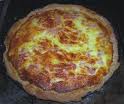
One evening while I was married to Jacky (my French ex-husband and still very dear friend), his sister invited us for dinner. In addition to other wonderful things she made a Tarte au Thon, essentially a tuna quiche. I have made it many times since myself, and whenever I serve it receive compliments and requests for the recipe. So voilà:
Tarte au Thon
Pie crust
4 eggs (5 if it is a large pie crust)
1 cup milk (2% works, but whole is best)
1 soup spoon of sour cream (In France they use crème fraîche; use that if you can find it)
2 medium (3 small) tomatoes
1 can tuna
1 cup swiss cheese
3 teaspoons of salt
1 teaspoon of pepper
Beat the eggs with a wire whisk. Add the milk, sour cream, salt and pepper and beat the mixture with the wire whisk again. Slice the tomatoes into rounds and lay these and the tuna out over the surface of the pie crust. Pour the egg mixture into the pie crust. Grate the cheese and sprinkle it over the filled pie crust.
Bake in a 425 degree oven for approximately 4o minutes (until browned).
Last week in a class with some of my Kindergarten-aged students we watched a youtube clip of the Millennial fireworks at the Eiffel tower.
After watching the video I had each of my students draw an Eiffel tower, instructing them to leave it completely bare. I then had the children exchange drawings with their classmates and decorate each other’s Eiffel towers. My students had the option of decorating their classmates’ Eiffel towers any way they chose; the only directive was to make them special for each other. It is hard to say which my students liked more; decorating their friends’ Eiffel towers or receiving the Eiffel towers their friends had created for them.
I would love to take full credit for the activity but it was the mother of one of the families I teach who inspired this communal drawing activity. She told me about a birthday game she knew of: Children sit in a circle at a table. Each child draws something on a paper and then passes the paper to the child to his/her right. That child turns the paper 90 degrees and adds another drawing before passing the paper to the child on his/her left. The activity continues until all the papers are decorated to the children’s satisfaction.
“Au Clair de la Lune” is a French folk song from the 18th century. It is one of France’s best known children’s songs and one of the first I teach the children who take my classes. Most people do not know however that it has the interesting distinction of having had its first couplet be the first ever recording of a human voice. Most people think that Thomas Edison’s “Mary Had A Little Lamb” had this notoriety, but in fact that is not the case. In 1857 Parisian inventor Edouard-Léon Scott de Martinville patented his “phonautograph”, a device that converted the sound of human speech into marks inscribed on a cylinder coated with lampblack. On April 9th 1860, fully 17 years before Thomas Edison’s “Mary Had A Little Lamb”, Scott de Martinville used his phonautograph to record a girl singing the first two verses of “Au Clair de la Lune”.
Below I have included clips of “Au Clair de la Lune”, de Martinville’s recording of its first couplet, the lyrics to “Au Clair de la Lune” and their English translation.
Au Clair de la Lune
Au clair de la lune
Mon ami Pierrot
Prête-moi ta plume*
Pour écrire un mot
Ma chandelle est morte
Je n’ai plus de feu
Ouvre-moi ta porte
Pour l’amour de Dieu
Au clair de la lune
Pierrot répondit
Je n’ai pas de plume
Je suis dans mon lit
Va chez la voisine
Je crois qu’elle y est
Car dans sa cuisine
On bat le briquet
Au clair de la lune
L’aimable Lubin
Frappe chez la brune
Qui répond soudain
Qui frapp’ de la sorte
Il dit à son tour
Ouvrez votre porte
Au dieu de l’amour
Au clair de la lune
On n’y voit qu’un peu
On chercha la plume
On chercha du feu
En cherchant d’ la sorte
Je n’ sais c’ qu’on trouva
Mais je sais qu’ la porte
Sur eux se ferma.
Au Clair de la Lune (English)
Under the moonlight,
My friend Pierrot
Lend me your pen*,
So I can write a note
My candle has died,
I have no more light
Open your door for me,
For the love of God.
Under the moonlight,
Pierrot replied,
I don’t have no pen,
I’m in my bed.
Go next door,
I believe they’re in,
Because there in the kitchen,
Someone lit a matchstick.
Under the moonlight
Nice Lubin
Knocks at the brunette’s door
She calls out:
Who’s knocking in this way
He replies:
Open your door
For the love of God.
Under the moonlight
Little can be seen
They looked for the pen
They looked for the light
With regard to their searching
I don’t know what was found
But I do know that the door
Closed behind them.
French lyrics, English translation and illustrations are from “Mama Lisa’s World: France” (http://www.mamalisa.com)
When the public school office of the 6th district of Paris summoned me to a meeting late last year, the tone of urgency in the letter sent me running down the block, into the 19th century courtyard of the town hall and up the narrow stairs to the top floor.
“What does your son eat for lunch?” the woman asked after I ran in breathless. I had no idea what to say. When my son started nursery school last September at the age of 3, I had registered him for the school lunch program. But when he failed to appear in the lunchroom after that, city officials quickly took notice. My explanation — that I thought he should take a break and eat lunch at home in the middle of the day — was apparently not sufficient. This was personal.
“The food is very good, Madame. The meat is 100% French,” the official said, picking up a brochure from her desk. I knew this brochure well, having e-mailed it to friends in the U.S. last year as a this-could-only-happen-in-France conversation piece. It lists in great detail the lunch menu for each school day over a two-month period. On Mondays, the menus are also posted on the wall outside every school in the country. The variety on the menus is astonishing: no single meal is repeated over the 32 school days in the period, and every meal includes an hors d’oeuvre, salad, main course, cheese plate and dessert.
There is more: the final column in the brochure carries the title “Suggestions for the evening.” That, too, changes daily. If your child has eaten turkey, ratatouille and a raspberry-filled crepe for lunch, the city of Paris suggests pasta, green beans and a fruit salad for dinner.
I finally saw the system in action earlier this month. Caught short by a sick nanny, my son, who was accustomed to eating leftovers from the refrigerator, sat in silence with his 25 classmates at tables in the nursery-school cafeteria, while city workers served a leisurely, five-course meal. One day, when I arrived to collect him, a server whispered for me to wait until the dessert course was over. Out in the hall, one of the staff shouted for “total quiet” to a crowd of 4-year-olds awaiting the next lunch seating. “I will now read you today’s menu,” he told them. “First, you will begin with a salad.”
Americans struggling with obesity epidemics have for years wondered how the so-called French paradox works: How does a nation that ingests huge quantities of butter, beef and cakes keep trim and have such long lives? It could be the red wine, as some believe. But another reason has to be this: in a country where con artists and adulterers are tolerated, the laws governing meals are sacrosanct and are drummed into children before they can even hold a knife. The French don’t need their First Lady to plant a vegetable garden at the Élysée Palace to encourage good eating habits. They already know the rules: sit down and take your time, because food is serious business.
In his new book Food Rules,Michael Pollan states in rule No. 58: “Do all your eating at a table.” French children quickly learn that they won’t be fed anywhere else. Snack and soda machines are banned from school buildings in France — a battle that is now raging across the U.S. And France’s lunch programs are well funded. While the country is cutting public programs and civil-servant jobs to try to slash a debt of about $2.1 trillion, no one has dared to mention touching the money spent on school lunches.
Public schools in France are overcrowded, rigid and hierarchical. And parents, who are never addressed by their first names, are strongly discouraged from entering school buildings, let alone the classrooms. I cannot tell you what my child learns, paints or builds on any given school day. But I do know that on Feb. 4, he ate hake in Basque sauce, mashed pumpkin, cracked rice, Edam cheese and organic fruits for lunch. That meant stuffed marrows and apples for dinner. The city of Paris said so.
When the public school office of the 6th district of Paris summoned me to a meeting late last year, the tone of urgency in the letter sent me running down the block, into the 19th century courtyard of the town hall and up the narrow stairs to the top floor.
“What does your son eat for lunch?” the woman asked after I ran in breathless. I had no idea what to say. When my son started nursery school last September at the age of 3, I had registered him for the school lunch program. But when he failed to appear in the lunchroom after that, city officials quickly took notice. My explanation — that I thought he should take a break and eat lunch at home in the middle of the day — was apparently not sufficient. This was personal.
“The food is very good, Madame. The meat is 100% French,” the official said, picking up a brochure from her desk. I knew this brochure well, having e-mailed it to friends in the U.S. last year as a this-could-only-happen-in-France conversation piece. It lists in great detail the lunch menu for each school day over a two-month period. On Mondays, the menus are also posted on the wall outside every school in the country. The variety on the menus is astonishing: no single meal is repeated over the 32 school days in the period, and every meal includes an hors d’oeuvre, salad, main course, cheese plate and dessert.
There is more: the final column in the brochure carries the title “Suggestions for the evening.” That, too, changes daily. If your child has eaten turkey, ratatouille and a raspberry-filled crepe for lunch, the city of Paris suggests pasta, green beans and a fruit salad for dinner.
I finally saw the system in action earlier this month. Caught short by a sick nanny, my son, who was accustomed to eating leftovers from the refrigerator, sat in silence with his 25 classmates at tables in the nursery-school cafeteria, while city workers served a leisurely, five-course meal. One day, when I arrived to collect him, a server whispered for me to wait until the dessert course was over. Out in the hall, one of the staff shouted for “total quiet” to a crowd of 4-year-olds awaiting the next lunch seating. “I will now read you today’s menu,” he told them. “First, you will begin with a salad.”
Americans struggling with obesity epidemics have for years wondered how the so-called French paradox works: How does a nation that ingests huge quantities of butter, beef and cakes keep trim and have such long lives? It could be the red wine, as some believe. But another reason has to be this: in a country where con artists and adulterers are tolerated, the laws governing meals are sacrosanct and are drummed into children before they can even hold a knife. The French don’t need their First Lady to plant a vegetable garden at the Élysée Palace to encourage good eating habits. They already know the rules: sit down and take your time, because food is serious business.
In his new book Food Rules,Michael Pollan states in rule No. 58: “Do all your eating at a table.” French children quickly learn that they won’t be fed anywhere else. Snack and soda machines are banned from school buildings in France — a battle that is now raging across the U.S. And France’s lunch programs are well funded. While the country is cutting public programs and civil-servant jobs to try to slash a debt of about $2.1 trillion, no one has dared to mention touching the money spent on school lunches.
Public schools in France are overcrowded, rigid and hierarchical. And parents, who are never addressed by their first names, are strongly discouraged from entering school buildings, let alone the classrooms. I cannot tell you what my child learns, paints or builds on any given school day. But I do know that on Feb. 4, he ate hake in Basque sauce, mashed pumpkin, cracked rice, Edam cheese and organic fruits for lunch. That meant stuffed marrows and apples for dinner. The city of Paris said so.
We have a friend who is leaving us for awhile.
He is going to see the world.
It is like that sometimes.
People love you but there are times they have to leave you for awhile.
For their own reasons.
It is hard, but it is like that.
You don’t like it but you have to accept it and wish them well.
You wish you didn’t but you do.
Because you love them, and you want what is best for them, even if it is sad for you.
That is how it is when you are grown up.
He is going to see the world.
And there is a lot to see.
We have some tips for him before he goes.
Friends always give tips.
They are as important as good luggage and hugs before getting on a plane.
I know of a tree in a castle on a bustling city street.
People drive past it every day and never even notice.
There are a million special things people miss all the time.
Like the man handing out four leaf clovers one day on a corner in that same place.
He gave me a handful once as people kept walking past.
Or the signs on the telephone poles that say “Jump” with a phone number
As if we could all change our lives and bound headfirst into our destinies
Just by dialing our phones.
People are too busy running by to see the marvels all around them.
Don’t be now. Or ever again.
Otherwise why bother going off to see the world?
Why bother trying?
You’ll never see anything unless you start looking.
Start today.
Be sure to climb mountains. Volcanoes too.
But be sure they are extinct first!
Swim in streams. But be careful:
Some are cold!
Notice little things.
Like how sometimes butterflies take a break from flying
And just glide.
Or how the wind sounds different different times,
depending on what kind of tree it’s in.
Eat whatever you want.
Vegetables will always be around.
This is an adventure after all.
Do whatever you want every day.
This is your adventure.
You have taken care of other people for a long time.
Now take care of yourself for awhile.
You have earned this time in the sun.
It’s your time and your sun.
Bask and play.
Just you and the sun.
No justification necessary.
And if anyone doesn’t understand or doesn’t like it,
They can find their own sunspot and do what they want there themselves.
And realize too that sometimes wonder is just in your own backyard after all.
Some people travel a lot and never see a thing.
Some people stay home and see the whole world.
Be one who has the best of both.
Not everyone will be nice to you.
But we are only a phone call or a postcard away.
And the stamp upside down means we love you.
When you are done with your travels come on back.
In your own time.
We will be waiting for you.
You have a place here too.
In our hearts.
Starmania is a French-language rock opera written by Luc Plamondon (Québécois) and composed by Michel Berger (French). It was first released as an album in 1978 and was performed as a musical the following year. The musical has been revived hundreds of times since then and performed throughout the world. It is generally considered to be the greatest French-language musical of all time. Whether or not that is the case, it is a creation of huge cultural importance, particularly in France and Québéc.
I discovered Starmania in 1989 when I was studying in Montréal. I bought the original album, so I like the songs as they were sung by the initial artists (the reprisals don’t “sound right” to me).
My absolute favorite song from Starmania is “Le Blues du Businessman” (sung by Claude Dubois). In the song an executive recounts his regret at having gone into business instead of becoming an artist as he would have preferred. “Le Blues du Businessman” is hauntingly beautiful and not surprisingly has become a classic, both in France and in Québec.
I found this video of Claude Dubois singing it in 1978. I get a kick out of this particular video because it feels so “retro”. There are dozens of videos of Claude Dubois singing “Le Blues du Businessman” because he continues to sing it even today. It is fun to watch several of the versions he has sung over time at different ages and compare the differences, not only in his appearance as time has passed but in his renditions of the song. This one though, is the coolest of them all.
LE BLUES DU BUSINESSMAN
paroles: Luc Plamondon
musique: Michel Berger
J’ai du succès dans mes affaires
J’ai du succès dans mes amours
Je change souvent de secrétaire
J’ai mon bureau en haut d’une tour
D’où je vois la ville à l’envers
D’où je contrôle mon univers
Je passe la moitié de ma vie en l’air
Entre New York et Singapour
Je voyage toujours en première
J’ai ma résidence secondaire
Dans tous les Hilton de la terre
J’ peux pas supporter la misère
Au moins es-tu heureux?
J’ suis pas heureux mais j’en ai l’air
J’ai perdu le sens de l’humour
Depuis qu’ j’ai le sens des affaires
J’ai réussi et j’en suis fier
Au fond, je n’ai qu’un seul regret
J’ fais pas ce que j’aurais voulu faire
Qu’est-ce que tu veux mon vieux
Dans la vie on fait ce qu’on peut
Pas ce qu’on veut…
J’aurais voulu être un artiste
Pour pouvoir faire mon numéro
Quand l’avion se pose sur la piste
À Rotterdam ou à Rio
J’aurais voulu être un chanteur
Pour pouvoir crier qui je suis
J’aurais voulu être un auteur
Pour pouvoir inventer ma vie (bis)
J’aurais voulu être un acteur
Pour tous les jours changer de peau
Et pour pouvoir me trouver beau
Sur un grand écran en couleur (bis)
J’aurais voulu être un artiste
Pour avoir le monde à refaire
Pour pouvoir être un anarchiste
Et vivre comme un millionnaire (bis)
J’aurais voulu être un artiste
Pour pouvoir dire pourquoi j’existe
(I have my office on top of a tower
From where I see the town upside down
From where I control my universe.
I spend half my life in the air
Between New York and Singapore
I always travel in first (class).
I have my second home
In all the Hilton’s on Earth
I can’t bear poverty.
At least are you happy?
I’m not happy, but I look like I am
I lost my sense of humor
When I developed business sense.
I succeeded and I’m proud of it
In fact I have only one regret
It’s not what I wanted to do.
Well, what can can you do?
In life you do what you have to, not what you want.
I wanted to be an artist
To be able to do my show
When the airplane touches the ground
In Rotterdam or Rio.
I wanted to be a singer
To be able to shout out who I am
I wanted to be an author
To be able to create my life.
I wanted to be an actor
So every day I would change personnas
And find myself handsome
On a the big screen.
I wanted to be an artist
To be able to be an anarchist
And live like a millionaire.
I wanted to be an artist
To to able to create the world as I want it to be
To be able to say why I exist.)
Mother’s Day is coming up, so I am thinking of my Mom a lot these days. It doesn’t really matter about Mother’s Day nearly being here actually; I think about her all the time anyway.
My Mom died three years ago at 62 years old. She was a beautiful, kind, intensely creative person. She was my first and most influential teacher and for that I am so, so lucky. She, more than any other person, event or experience, made me who I am today. That is an amazing thing to say (and for her part she would have loved hearing it and absolutely never believed it) because at nearly 44 years old I have been a fair number of places, experienced a pretty wide range of things and met more than a few people. What I said about my Mom’s importance is true though, and I see it more every day. I see it in the way I relate to people, and in how I experience the world. I teach people of all ages and levels, including quite a lot of children. My work with them is where I see my Mom’s impact on me the most.
My Mom stayed home with me and my sister. As a kid I was utterly unimpressed by that, most especially as a preteen and then as a teenager. I remember one day when I was about 13 telling her that when I grew up I was going to be someone important, not like her. “What I do is important” she said. “Yeah,” I said “but I’m going to be in the encyclopedia.”
It sounds like an innocuous enough comment, but that is because the written word does not convey my snideness. I really regret undervaluing my Mom that way, particularly because the moment I am describing here was not the only time I did it. These days being in the encyclopedia is no big deal; pretty much anybody can make it into Wikipedia. Back then though we bought our encyclopedias in installments and not every family had one in their home (We did). If a kid’s family did that was pretty much a sign his/her parents, in addition to being fortunate enough to be able to afford one, really wanted him/her to grow up to be a well-educated “successful” person. I am guessing that sort of public esteem for the encyclopedia is where I got the idea to say such a thing.
When I tell people this story they find it amusing. I do not. For me it embodies all the arrogance (and there was plenty of it, unfortunately) I carried around as a kid, and for a long time after that. I’ve read Lacan, Freud and Jung on the stages of consciousness and maturity and I’ve talked to mothers and specialists of Human Development. They all tell me my comment was just normal kid behavior and that being treated like an idiot comes with the territory of parenthood and especially with being the mother of a 13 year old girl. I see my students treat their mothers that way, and have for over 20 years. If my mother even remembered that comment as the years passed she would no doubt have found it adorable. I do not. I remember that comment as if I had made it only yesterday. And I can’t say that for a lot of comments. I haven’t been nice to all the people in my life all the time and some bad or at least unfortunate things have happened to me over the years. There’s not much I regret though, or that I would do differently. That one moment with my Mom though, I would change if I could.
When I got my Ph.D., and I don’t mean just the day I got it, I mean ever after I got it, my Mom would (and here I am being absolutely, 100% serious and literal) stop people on the street and tell them “My daughter is a doctor”. Imagine. Unbelievable, right? But that’s how she was, how much she loved me and how incredibly proud she was of me. Right up to the end. And way before I ever got the doctorate. I mean all my life. The Ph.D. was just another of her pretexts to tell people how great I was. For her I think my Ph.D. was as much hers as it was mine. And I mean it sincerely when I say she deserved it more.
I remember one morning in my first year of teaching, high school at that point, we were talking and I had to rush off the phone to make it to my French class. As we hung up she said “You go teach those kids French”. It was an offhand comment, really just akin to a goodbye. But I still think of it all the time when I am on my way to teach, especially my little kid students. I think how proud she would be to know that I teach so many little kids now, that I’m good at it, and that my work with them means so much to me.
These days I think that really just about the most important (and powerful) thing you can do is to touch and help form the life of a kid. My Mom would laugh and then smile to hear me say that. And then she would tell it (proudly, again and again) to everyone she knew. And then to everyone she didn’t too.
I am lucky to have had my Mom, and for as long as I did. I am so blessed to have had her as a mother, as a mentor, as a friend. She made me who I am. And thank God, so infinitely much more bearable than I would have been without her.
Happy Mother’s Day to all you Moms; please know how important you are in your children’s lives. If they never get around to telling you, please hear it from me and know it really comes from them.
I love you Mom. Thank you for all the things I know to thank you for. And thanks for all the rest too.
Below I have inserted a video my sister made in 2007 for our first Mother’s Day without my Mom.
You have almost undoubtedly seen the Évian roller-skating babies commercial that came out this past summer. With 2.8 million hits on youtube in the U.S. and another 2.3 million internationally in its first week alone it quickly became one of the most popular videos on the internet.
It’s a lot of fun, so just in case you haven’t seen it, or if you have seen it and want to see it again, here it is:
Mr. B’s is one of the New Orleans restaurants run by the Brennan family. If you haven’t heard of the Brennans, they are known as “the first family of New Orleans cuisine”. They own the renowned Brennan’s and Commander’s Palace restaurants. Mr. B’s is one of their more casual restaurants.
I lived in New Orleans for four years while working on my Ph.D. at Tulane. One evening during that time I went to Mr. B’s with a friend and our waiter gave us their recipe for “Barbequed Shrimp”. The name is deceptive; there is no barbeque sauce involved and the shrimp is sauteed on the stove, not grilled. . .Whatever the reason for the name the dish is incredible. I have made it a number of times and in each instance my guests have raved about it, including French guests. . .
New Orleans Barbequed Shrimp
14 large fresh shrimp, unpeeled with the heads on
6 tablespoons of cold unsalted butter, cut into 1 ounce pieces
1 ½ teaspoons of ground black pepper
1 1/2 teaspoons of cracked black pepper
1 teaspoon of creole seasoning (recipe given below)
3 tablespoons of Worchester Sauce
1 teaspoon of chopped garlic
juice of one lemon
Place the shrimp and all the ingredients, except the lemon juice and 3 ounces of the unsalted butter in a sauté pan large enough so that the shrimp are in one layer. Begin to sauté over moderate heat. Add the lemon juice and mount the remaining 3 tablespoons of cold butter by swirling the pan and stirring with a fork. Serve the shrimp in a bowl and pour the sauce over the shrimp. Garnish with hot French bread for dipping.
 One evening while I was married to Jacky (my French ex-husband and still very dear friend), his sister invited us for dinner. In addition to other wonderful things she made a Tarte au Thon, essentially a tuna quiche. I have made it many times since myself, and whenever I serve it receive compliments and requests for the recipe. So voilà:


